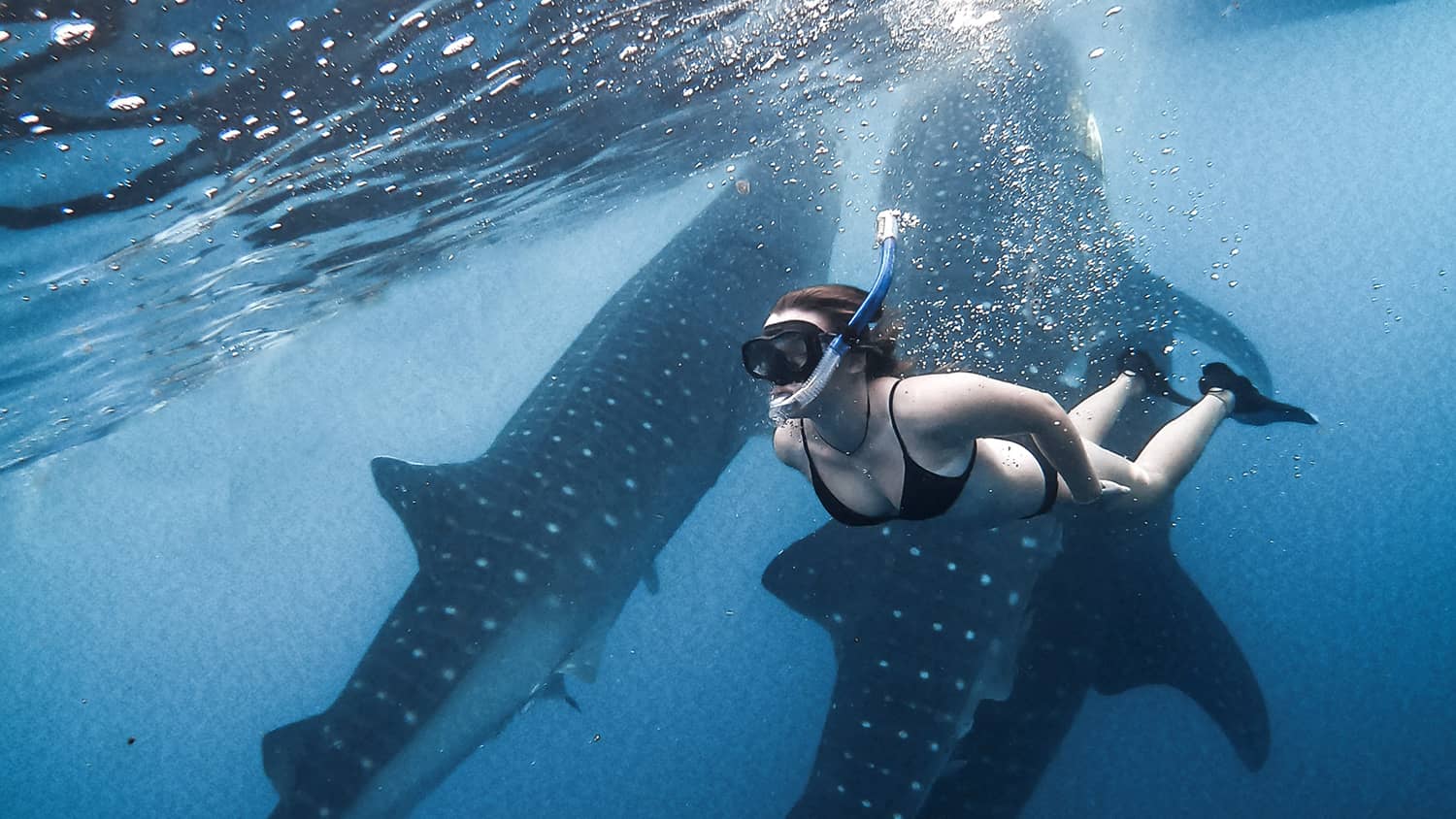
Before I ever saw a whale shark in real life, I thought I already admired them. I’d seen the documentaries, the drone shots, the underwater GoPro footage of those dotted giants moving slowly through blue water. It all looked majestic, mysterious, and honestly a bit unreal. But it wasn’t until I floated just above one in the open waters of Saleh Bay, heart pounding, mask fogging up, that something clicked in a totally different way.
There’s a big difference between admiring from afar and understanding up close. Because the more you learn about whale sharks—how they live, what they need, how delicate their world really is—the more deeply you fall for them. Not just because they’re big and beautiful, but because they are gentle, complex, ancient creatures with stories etched into every spot on their skin.
Learning about whale sharks doesn’t make them less magical. It makes the magic personal.
They’re Not Whales—And That’s Just the Start
Let’s clear something up. Despite the name, whale sharks aren’t whales. They’re sharks. The biggest fish in the ocean, actually. But unlike the toothy image you might associate with sharks, whale sharks are filter feeders. They don’t hunt. They don’t attack. They glide through the sea with mouths wide open, filtering plankton and tiny fish like they’re peacefully sipping the ocean.
I remember learning that on the boat ride out to my first whale shark encounter in Sumbawa. One of the guides laughed when someone asked if it was dangerous. “Only if you’re plankton,” he said.
It was both funny and humbling. Here I was, nervous and excited, about to meet an animal that could fit a car in its mouth—and all it wanted to eat was microscopic sea soup.
That contrast—their size vs. their softness—is part of why they’re so easy to love once you really start paying attention.
Every Spot Is Unique
I didn’t know this until after my dive, but each whale shark has a unique pattern of spots, like a fingerprint. There’s even a global database where researchers log photos of these gentle giants using software originally designed to map stars.
That blew my mind. It also made the experience of seeing one in the wild feel even more intimate. Because that wasn’t a whale shark. That was that whale shark. An individual. A living story. Maybe it had traveled thousands of kilometers before meeting me. Maybe it had been logged by scientists in another part of Indonesia.
Suddenly, I wasn’t just watching nature—I was meeting someone.
And when you make it personal like that, everything changes. You start wondering where they go when they’re not here. You start asking how long they live (70–100 years). You start noticing the scars on their fins, the patterns on their sides. You start caring in a whole new way.
Whale Sharks Are Ancient Beings
We’re talking prehistoric. Whale sharks have been around for millions of years. Long before humans started sailing or writing or chasing sunsets around tropical islands, these creatures were gliding through the sea.
There’s something about being in the water with an animal that old—it rearranges your perspective. It makes your life feel small, but not in a bad way. Small like you’re part of something much bigger. Like you’ve been let into a very old story, and you’re lucky to even witness a paragraph of it.
During my whale shark diving Sumbawa trip, I remember coming out of the water and just sitting quietly. Not because I was tired, but because I was trying to take it all in. What had I just experienced? What kind of being had I just floated beside?
You don’t get that kind of reflection from every trip. But this was different.
They’re Wild—But They Let You Close
One of the most incredible things about seeing whale sharks in Saleh Bay is how naturally it happens. You’re not watching from a tank or chasing them with motors. You’re entering their space, quietly, respectfully.
The guides explained how these whale sharks sometimes gather near traditional fishing platforms (bagan) because of the small fish in the water. But nothing is forced. The whale sharks choose to be there. They come and go as they please.
That kind of encounter hits differently. You’re not there to “see a thing.” You’re there to witness a moment—if it happens. And when it does, it feels like a gift.
That’s why a good Saleh Bay whale shark tour doesn’t feel like a transaction. It feels like an invitation. You’re entering a natural rhythm that existed long before you, and hopefully will continue long after.
They Travel Farther Than You Ever Will
Whale sharks are ocean wanderers. Some are believed to migrate thousands of kilometers each year. Scientists are still trying to understand their full patterns, but what we do know is impressive: they dive deep (over 1,000 meters), they cross borders, and they seem to follow food and seasons with the wisdom of the sea in their blood.
When I swam next to one in Sumbawa, I kept thinking—where has this one been? Has it passed the Philippines? Cruised past Australia? Will it one day be spotted near Madagascar?
It reminded me how little we know about the oceans, and how much more there is to protect. These creatures are not “ours.” They belong to the world. And yet, when you meet one, it feels like the world is standing still just for you.
They Depend on Us More Than Ever
Here’s the part that hits hardest the more you learn. Whale sharks are vulnerable. Listed as endangered by the IUCN. Not because of tourists—but because of human activity.
Fishing nets. Boat strikes. Plastic in the oceans. Irresponsible tourism in some places.
That’s why how you meet them matters.
One of the things I appreciated most about my Sumbawa trip was how much emphasis the crew placed on respect. No touching. No feeding. No diving down to chase them. Just calm observation. Floating. Breathing. Letting them come to you.
It sounds simple, but it makes a world of difference—for the animals and for your experience.
And once you’ve seen one up close, really seen it—not just snapped a photo—you want to do better. You want to protect their space. You want other people to have the chance to meet them like this too.
They Show You What Travel Could Be
Some trips give you memories. Whale shark trips give you values.
Since returning from that first encounter, I’ve noticed how it’s changed the way I travel. I move more slowly now. I ask more questions. I pick experiences based on impact, not just images.
I care more about the how, not just the where.
And that mindset started in the ocean, beside a spotted giant who never said a word but taught me everything I needed to hear.
The more you learn about whale sharks, the more your heart opens. They stop being just “cool animals” and start becoming teachers, guides, even silent friends who remind you how to move through the world with care.
If you ever get the chance to go whale shark diving Sumbawa, don’t just go for the photo. Go for the understanding. The connection. The shift in perspective that comes from meeting a wild, peaceful being who doesn’t need to impress you to earn your love.
They just need you to notice.
And once you do, you’ll never forget them. Not just for how they looked—but for how they made you feel about the ocean, about nature, and about your place in it all.